Archives for category: Clips

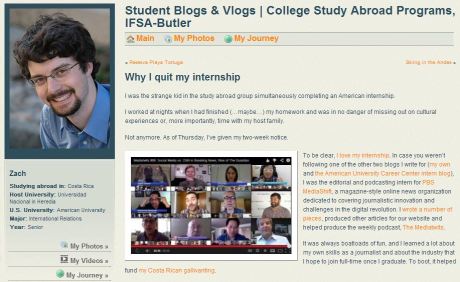
'Why I quit my internship'

It’s with a heavy heart that I announce that I’ll be leaving PBS MediaShift (and it’s podcast, Mediatwits) on Sept. 4.

Long story short, I realized I needed to spend more time on my academic pursuits (especially when all of my homework is in Spanish) and exploring Costa Rica to its fullest extent.

Read this post on IFSA-Butler’s Study Abroad blog on my reasoning to give up the best internship I’ve ever had.

Thanks to Steff Dazio, Paige Jones, Rachel Karas and probably other people who told me to do this a long time ago and waited for me to make my own decision. I appreciate your patience and your concern for my well-being.


Digital disruption has changed the landscape of the media world, and journalism and communication schools need to figure out how to educate in a time of vast change. The schools themselves need to change too, or risk falling behind. As part of this week’s special “Back to J-School 2013,” in-depth report at MediaShift, this episode of the Mediatwits will talk to students and professors alike on the value of a journalism education, the future of education innovation and more. Special guests this week are Howard Finberg, creator of NewsU at the Poynter Institute;Eva Avenue, former editor-in-chief of the Daily Lobo at the University of New Mexico; and San Diego State University professor and Knight Center MOOC coordinator Amy Schmitz Weiss. MediaShift’s Mark Glaser hosts, along with Andrew Lih from American University.

Check out a rundown of all the latest research on this topic, as well as guest bios.

IFSA blog 8.22.13 2

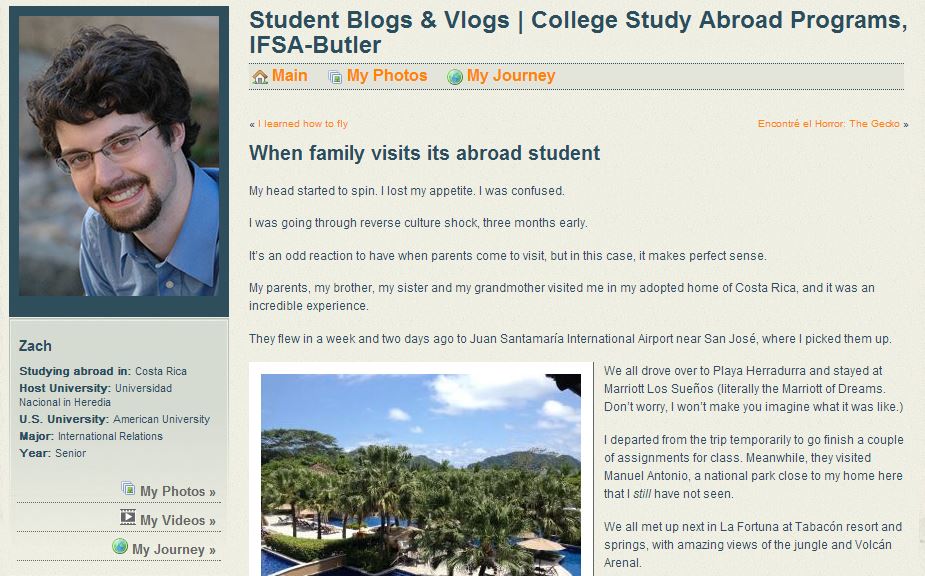
My head started to spin. I lost my appetite. I was confused.

I was going through reverse culture shock, three months early.

It’s an odd reaction to have when parents come to visit, but in this case, it makes perfect sense.

Read the rest of the posts and check out some awesome pictures of hanging bridges, jungle vines, and, of course, Volcàn Arenal.

IFSA blog 8.22.13

So not a particularly Costa Rican activity, but when I visited Playa Herradura, I got a chance to try out FlyBoarding.

The method of FlyBoarding is pretty simple. A large hose simply funnels exhaust water into a board. The water then pushes the rider above the water as much as 20 feet, and the rider has to balance, like on a snowboard on a spinning top.

Check out the photos here.

It just seems a natural extension of my rabbinate.
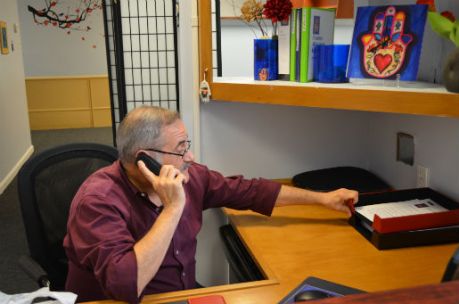
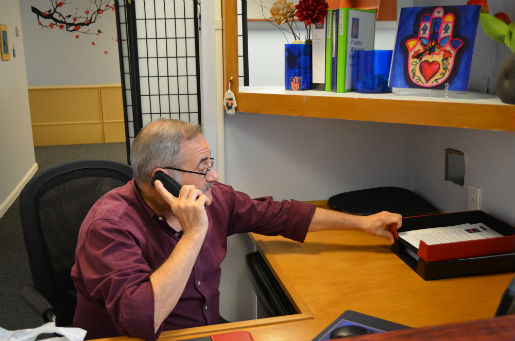
Rabbi Jeffrey Kahn is the owner of D.C.'s newest medical marijuana dispensary, in Takoma Park. Photo by Zach C. Cohen.

Rabbi Jeffrey Kahn is the owner of D.C.’s newest medical marijuana dispensary, in Takoma Park. Photo by Zach C. Cohen.

WASHINGTON – When Rabbi Jeffrey Kahn told his former congregants that he was opening a medicinal marijuana dispensary, they were nothing but supportive.

“The cannabis plant was created by God on the second day of creation when God created all the other plants, and touching this one isn’t forbidden,” Jeff said in a June interview.

As somebody who “came of age as a rabbi during the age of AIDS,” Jeff’s no stranger to the pain felt by those without the access to the medicine they need.

And as “a lifelong educator,” Jeff said the Jewish aspect of the work he does now is strong. He still teaches people to question preconceived falsehoods, whether it’s in Hebrew School or about medicinal marijuana. The fact that that education can then lead to people getting the medicine they need makes it all the more Jewish.

“The whole idea of breaking through those kinds of barriers and being able to help to connect people to what can really help them, it just seems a natural extension of my rabbinate and a natural extension of what’s important to me about how Judaism views life and the world,” Jeff said.

When you’re sick, Jeff said, it’s OK to eat on Yom Kippur. The inverse is true: As Jews, we have a responsibility to help those that are sick even when we should be praying.

“The mitzvah of helping people is more important,” Jeff said.

So Jeff ended his 30-year career as a congregational rabbi and dedicated three years of his life, attending countless local government meetings; speaking with local business owners, neighbors and even D.C. Councilmember Muriel Bowser; and renting a space for two and a half years — all before he even knew if the center would open.

That day finally came Aug. 1, and the Takoma Wellness Center has served three customers.
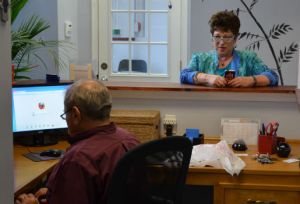
Stephanie Reifkind Kahn, background, talks to her husband and Jeff. Photo by Zach C. Cohen.

Stephanie Reifkind Kahn, background, talks to her husband Jeff, at desk. Photo by Zach C. Cohen.

Jeff worked full time to get the clinic up and running while his wife, Stephanie Reifkind Kahn, continues to work as Specialty Hospital of Washington Hadley’s director of performance improvement and regulatory compliance.

“We’ve been in the helping professions for our entire lives,” Stephanie said.

In a town known for a bureaucracy that citizens love to hate, the Kahns optimistically filled out their 350-page application in November 2011 and followed the constantly-revised rules that will eventually regulate the 1999 decision by D.C. residents to legalize medicinal marijuana.

“The Department of Health, although they’ve been very slow, have been very positive,” Stephanie said. “They just really want to get it right. There’s been so many problems in other places. Everyone is very aware that this is our nation’s capital, and they don’t want to have problems.”

And neither do the Kahns. The Takoma Wellness Center is set in a safe, northwestern outskirt within the District’s borders, right by the Metro that takes passengers right into the heart of D.C. The door to the shop, framed in a tan, brick arch and a gravel driveway, has not one, but two doors between unseemly types and the clinic’s lobby. The Kahns want no business with drug use’s “counter-culture,” and security will be tight with the help of a guard checking IDs and security cameras trained on the entrance.

Those who visit the clinic will be benefitting charity as well, since all of the center’s profits will go to non-profits in the local area.

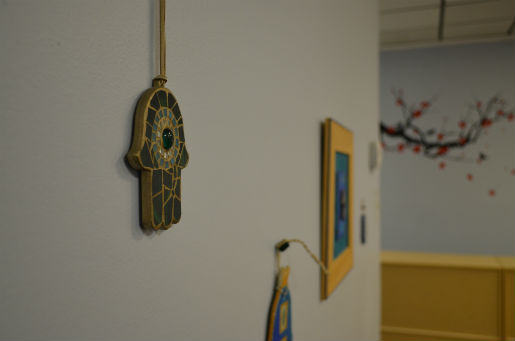
The wall of the then-yet-to-be-opened Takoma Wellness Center featuring hamsas, a traditional Jewish symbol. Photo by Zach C. Cohen.

The wall of the then-yet-to-be-opened Takoma Wellness Center featuring hamsas, a traditional Jewish symbol. Photo by Zach C. Cohen.

Once inside, the pale blue-gray walls feel like your neighborhood doctor’s office. The office walls are lined with hamsas, the Jewish symbol to ward away evil. Most of them belong to the Kahns and are from Israel.

“I really love them because the idea of healing and protection, and also because of harmony,” Stephanie said.

Past the lobby, a private consulting area for patients examining various types of marijuana both with and without THC, including Jack Herer, OG Kush, Master Kush and Blue Dream (all four of which are grown in D.C. by cultivators licensed by the D.C. Department of Health). They can weigh the benefits and disadvantages of different consumption methods: smoking, vaporizers;  cooking it into butter or oil; tinctures; pills. There’s also a library with about two dozen books and a stand with more literature on medicinal marijuana.

“We really wanted it to not look like anything having to do with counter culture, that it looks warm and professional and a place that anybody could come in and feel comfortable,” Stephanie said.

There’s still stigma attached to dealing marijuana, even when it’s legal. But the Kahns said they’ve heard only support from their loved ones.

“A few years earlier, maybe not even 10, it would have been different,” Jeff said. “I think we would have gotten less support.”

Jeff and Stephanie have encountered those stigma. Stephanie’s mother and father suffered from diseases that would have benefitted from the drug. Her father, Jules Reifkind, had multiple sclerosis, her mother, Libby, had lung cancer. Their doctors both prescribed medicinal marijuana, and her father benefitted greatly from its healing properties.

When his doctor first told him to take marijuana, “my father was very, you know, middle class business man, and this was the ‘70s, and he was like, ‘Are you high?’” Stephanie said.

“Finally he did, and it made a huge difference,” Stephanie said. Jules died in 2005 at the age of 75.

But Libby never received that treatment, since she died two months after being diagnosed in 2009.

There will come day, Jeff said, when dispensaries won’t be necessary, when marijuana will be treated like any other prescription drug, when people like Stephanie’s parents won’t have to suffer when the drug they need is illegal.

“In the meantime,” Jeff said, “this a great way to be able to make sure people can get their medicine safely — safe medicine — without having to go to dangerous places to get it.”

This piece was updated 4:47 p.m. on Aug. 19 with new information from Jeff Kahn regarding the opening. 

To syndicate this piece, please contact me. You can also follow me on Twitter, Facebook, and on my blog

Start the conversation below: Did the Kahns make the right move? Is it appropriate for a rabbi to open a medical marijuana dispensary in the nation’s capital?

UPDATE Aug. 18: This piece has been republished by New Voices Magazine


It’s a scary but exciting world for newspaper owners right now, especially if they’re in a selling mood. Jeff Bezos, the founder and CEO of Amazon, bought the Washington Post last week (while our podcast was on vacation — great timing!), and Red Sox owner John Henry bought the Boston Globe before that. As newspapers continue to struggle to raise advertising or subscription revenue, will the journalism industry be aided or hindered when it’s owned by billionaires? Special guests Nick Wingfield from the New York Times and Jack Shafer from Reuters join this week’s episode of the Mediatwits. MediaShift’s Mark Glaser hosts, along with Mónica Guzmán from the Seattle Times and GeekWire, Ana Marie Cox from the Guardian and Andrew Lih from American University.

 
Check out guest bios and story research.

'Storify: Jeff Bezos Shocks the World, Buys Washington Post'

D.C.’s hometown paper announced Aug. 5 that Jeff Bezos, founder of Amazon, bought the Washington Post and a number of other Post Co.-owned newspapers for $250 million. The Post has been controlled by the Graham family for 80 years. Here’s how journalists — at the Post and beyond — reacted to the news, as well as all the background on Bezos and his deal with the Grahams.

See the full Storify here.

UPDATE Aug. 7, with reader reactions:

I don’t always read Storifys about breaking media news, but when I do, I prefer Storifys compiled by Zach C. Cohen.
Rhys Heyden, staff writer San Luis Obispo New Times and former classmate at American University

IFSA blog 8.5.13 2

New campus. New students. New professors. New subjects. New regulations. New languages.

All of the change associated with studying at a new school is enough to drive even the most competent student mad.

Here are a couple of tips I picked up from my experience of “syllabus week” at a foreign university.

Read the tips here, and add your own!

IFSA blog 8.5.13 1

It seems completely counter-intuitive to send study abroad students to a completely different place for their first week of orientation, only to shuttle them off to a completely new town with completely new family.

It’s paramount to doubling the culture shock, antithetical to IFSA’s promise of “More culture. Less shock.”

But, by George, it works. Transition to university has been easier than I could have imagined, no small thanks to my time in Liberia.

Read the rest of my explanation here. 

washingtonpost.com front page, Aug. 5, 2013

washingtonpost.com front page, Aug. 5, 2013

The Washington Post announced this afternoon that Jeff Bezos, the founder of Amazon, will buy the venerable paper and a number of other Post Co. newspapers for $250 million.

For any D.C. denizen, and for journalists across the world, this will come as a shock with a mix of apprehension.

I’m most certainly in that camp. Granted, it’s not surprising that The Post would need drastic change to survive the Internet age, like other newspapers across the country.

But the fact that the Graham family would sell the paper, and to the guy who founded Amazon to boot, seems just a little bizarre.

But let’s put this deal in perspective. The reporters and editors of The Post will still produce incredible journalism. All of the top management people are staying, including Katharine Weymouth, the fourth generation installment of the Graham family, who has owned The Post for 80 years. Bezos said he won’t even be involved in the day-to-day workings of the newspapers he just bought. And to clarify, Bezos is the sole owner of The Post, not Amazon. It seems The Post’s tradition of proprietary ownership is alive and well.

The Post already has an excellent leadership team that knows much more about the news business than I do, and I’m extremely grateful to them for agreeing to stay on.

– Jeff Bezos

Who owns the company won’t change the paper’s reporting excellence.

Especially over the past four decades, The Washington Post has earned a worldwide reputation for tough, penetrating, insightful, and indispensable journalism. With the investment by Mr. Bezos, that tradition will continue.

-Katharine Weymouth

To be blunt, not all of Bezos’s investments have worked (see Pets.com and Kozmo.com).

However, according to the Washington Post:

Amazon’s sales have increased almost tenfold since 2004 and its stock price has quadrupled in the past five years.

It’s easy to see why. Bezos founded a company that has revolutionized more than one media industry. Just think about “Earth’s Largest Bookstore,” the Kindle, Kindle Singles (Amazon’s own brand of journalism).

In naming Bezos its “Businessperson of the Year” in 2012, Fortune called him “the ultimate disrupter…[who] has upended the book industry and displaced electronic merchants” while pushing into new businesses, such as TV and feature film production.

People much smarter and more well-informed than I will bring new facts to light and new analysis over the next few days. Take those predictions, and my own, on the future of D.C.’s hometown paper with a grain of salt. If somebody had the secret potion to make journalism profitable, we haven’t heard from them.

I’m optimistic that Jeff Bezos is just what The Post and affiliated newspapers need to thrive, not just survive.

Full disclosure: I am a daily print subscriber to The Post as well as an avid Kindle user, despite that one time Amazon failed to send me a book after I paid for it (don’t worry, I got a refund). 

Sources