Do you love photo and video sharing? Then this episode is for you. First, Facebook announced that popular photo sharing and filtering service Instagram will add video to compete with the popularity of Vine, owned by Twitter. Meanwhile, a photographer has sued BuzzFeed for just that kind of sharing, claiming $3.6 million in damages for using his photo of a soccer player — and enabling sharing on other sites. We’ll talk to copyright lawyer Richard Stim of Nolo on the validity of the case and the role of copyright in digital journalism. Then, we’ll talk to Northwestern University in Qatar’s Dean Everette Dennis about his new study on media use in the Middle East, and the growing use of mobile phones for news there. MediaShift’s Mark Glaser hosts, along with Mónica Guzmán from the Seattle Times and GeekWire.
Meet the guests and get the facts here.
My take on Instagram’s new video capability:
What I’m most actually interested in is this Cinema app that they have attached to Instagram video, which basically lets you in post-production stabilize a really shaky video. And in my mind that has a lot of really great implications for citizen journalism, right? If you’re at a breaking news event and you’re trying to catch video, but you’re running around and it gets all shaky and it kind of lowers the quality of it. And I really like what the CEO said during the big press conference yesterday, where he said, “you know, we shouldn’t have to accept bad video.” So I really like where Instagram’s going in improving that aspect of it.
All of my reporting on the Personal Democracy Forum in New York City last weekend.
A full story for PBS MediaShift:
With reports that the National Security Agency is amassing data from Internet and phone companies, jokes abounded at the 10th annual Personal Democracy Forum (PDF) in New York City on June 6 and 7, especially when the list of sponsors for PDF sounded like a tally of NSA’s tech titan collaborators — Google, Facebook, Yahoo, etc.
But against the backdrop of Silicon Valley and government snooping on citizens, speakers held “big data” in high regard and pointed to a number of technologies that had the potential to amass tons of raw data for analysis and democratization.
A bunch of photos:
A dispatch on “Mediatwits”
And a reflective essay for the American University Career Center on how I was able to go:
Interning can be expensive. Living, eating, transportation. It makes it hard for people of limited resources to have the opportunity to intern. That’s why a federal judge on June 11 ruled, with potential implications for the intern market, that, in one case, interns should have been paid for doing work.
I’m lucky to be supported financially during my internships. But transportation, especially to conferences, turned out to be the most expensive part for me.
My first time on the “Mediatwits” podcast was last week. Take a look behind the scenes at my tech issues, and check out the episode itself.
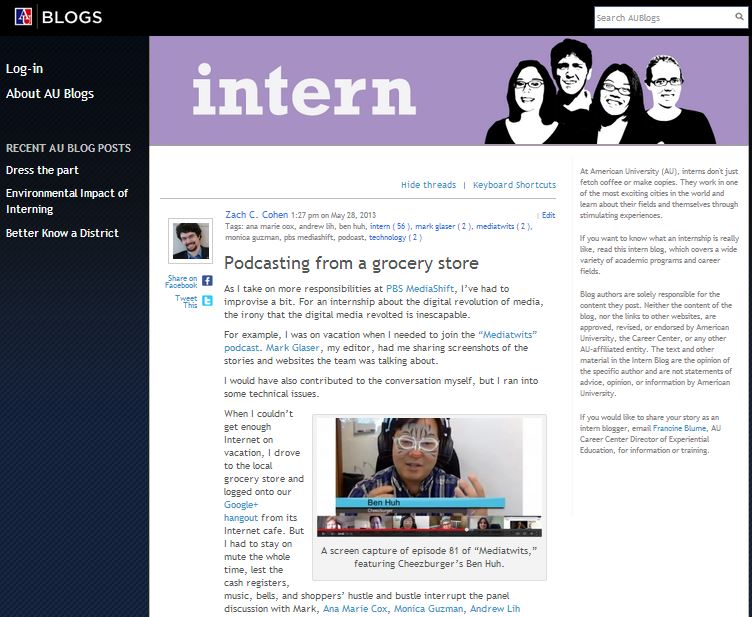
As I take on more responsibilities at PBS MediaShift, I’ve had to improvise a bit. For an internship about the digital revolution of media, the irony that the digital media revolted is inescapable.
For example, I was on vacation when I needed to join the “Mediatwits” podcast. Mark Glaser, my editor, had me sharing screenshots of the stories and websites the team was talking about.
I would have also contributed to the conversation myself, but I ran into some technical issues.
 Zach C. Cohen