Archives for category: Journalism

I was in 4th grade on Sept. 11, 2001.

While most of the world knew what had happened in New York, D.C. and Pennsylvania, I was in the dark until about 3 p.m.

The only hint I got that something was off: We held recess indoors on that beautiful sunny day.

I met both Mom and Dad at home right after school. I remember thinking how strange that was, since my father was never home that early.

They told me everything as we huddled around the kitchen counter. About the planes. About the towers. That my aunt living in New York City was safe but that friends of friends who worked in Manhattan were not.

I went to class the next day and heard the harrowing tale of how my 4th grade teacher went through the whole day without mentioning the attacks, instead continuing to teach as if the world were not crashing down around us and as she shook from head to toe. Live coverage of the attacks played in the teacher lounge but far from the eyes and ears of impressionable elementary school students. Senior school administration decided it best to let parents explain this day to their children.

I went to Hebrew School and sat in a special session with all of the grades together.I asked a question about “the World Trade Center and the Twin Towers,” and they quickly corrected me, saying they were one in the same.

I clearly did not know what was going on.

I didn’t know what a Pentagon was.

I didn’t know who attacked the U.S., or why they did it.

And I certainly didn’t realize just how much it would affect me, and the world I live in, for the rest of my life.

***
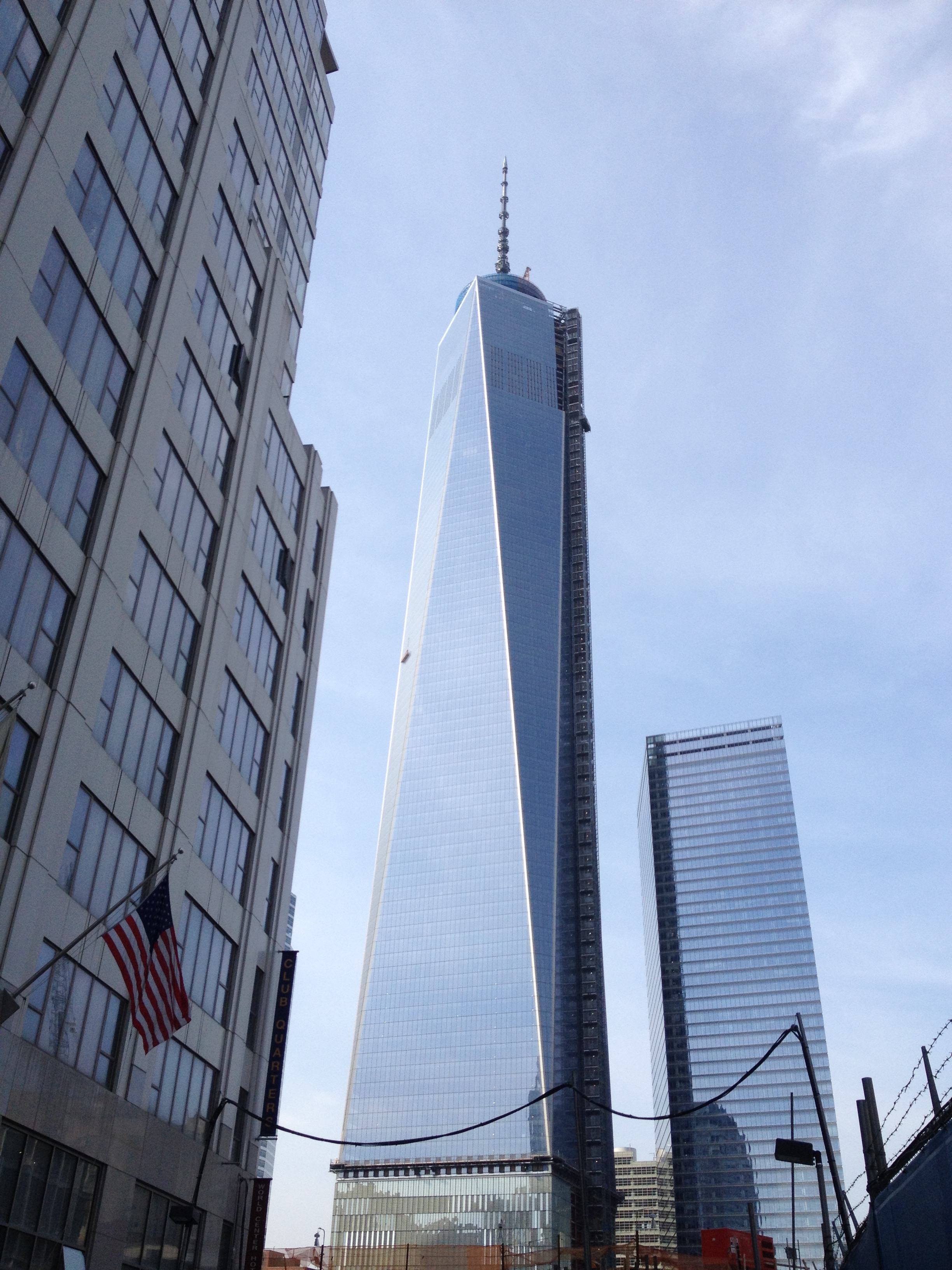
One World Trade Center, June 2013. Photo by Zach C. Cohen

One World Trade Center, June 2013. Photo by Zach C. Cohen

12 years later, I have a much better understanding.

I’m not sure if I was clueless then because I could connect the dots (I wasn’t the sharpest kid back then) or because I couldn’t grasp the magnitude around what happened.

12 years later, I still don’t know how it has affected me.

But I do know that almost 12 years later that I’ve been affected.

I know I felt pride and awe when I saw One World Trade Center rising into the sky.

I know I felt chills when I saw the name of Dana Ray Hannon, a firefighter with Engine 26 from my hometown of Wyckoff, N.J., just across the river from Manhattan. His name has been etched into the stone for the ultimate sacrifice he made that day. I still remember singing with that same 4th grade class at the unveiling of his memorial at Wyckoff’s fire department headquarters.

I know I felt empty saw the gaping hole where a tower used to be, the footprint massive, deep and eerily silent with the exception of a thunderous waterfall.

The World Trade Center memorial in June 2013. Photo by Zach C. Cohen.

The World Trade Center memorial in June 2013. Photo by Zach C. Cohen.

And I cried.

***

12 years later, I’m still afraid. Not of terrorists. And certainly not of Arabs and Muslims.

The only thing we have to fear is fear itself.

As a journalist, I do not hold many biases or opinions so I can look at political issues with a clear head and a keen eye.

But I have no problem publicly standing by the First Amendment and basic human decency.

As a journalist, it is my duty to defend freedom of speech.

As a Jew, it is my duty to defend against bigotry.

As an American, it’s my duty to defend both.

I’m still afraid because, like I wrote in 2010 for AmWord and again for the Suburban News, Islamophobia is still rampant in the United States, and Arabs and Muslims are still targeted unfairly for sharing a heritage with the 19 men who attacked the United States 12 years ago. Just earlier today, Pastor Terry Jones was arrested with thousands of kerosene-soaked Qurans.

And I’m still afraid for our ability to speak up on exactly these issues. If I was as smart as Jeff Jarvis, I would say:

I am disgusted at every revelation from Edward Snowden, Glenn Greenwald, and the Guardian about the massive violation of essential rights committed by the NSA. I worry greatly about the chill this puts on speech, on assembly, and on the advancement of technology. I don’t blame the spies. Cats must kill, spies must spy. I blame our leaders for not doing their single most important job: protecting freedom.

…Now that the 9/11 Memorial is complete, every activity of the day is being held there, closed behind wire and walls. I could barely hear the bagpipes in the air.

That the 9/11 Memorial and today’s remembrances are held in a fortress is emblematic of the wrong path we have taken these 12 years: not toward openness but toward isolation, not toward generosity but toward defense, not toward principles but toward expediency. We should be closer to freedom. We are farther away.

I’m afraid because we have not learned the right lessons from 9/11. We have not learned tolerance and peace.

***

All day has felt like a blur to me. In Costa Rica, 9/11 is not exactly on the national psyche, which in and of itself was a surreal experience.

My only connection to 9/11 today was the flood of comfort on Facebook from friends to those who lost loved ones on 9/11, as well as an incredibly moving story of grief and confusion.

But with an event as gigantic as 9/11, both in scope and import, it makes me wonder if condolences are sufficient.
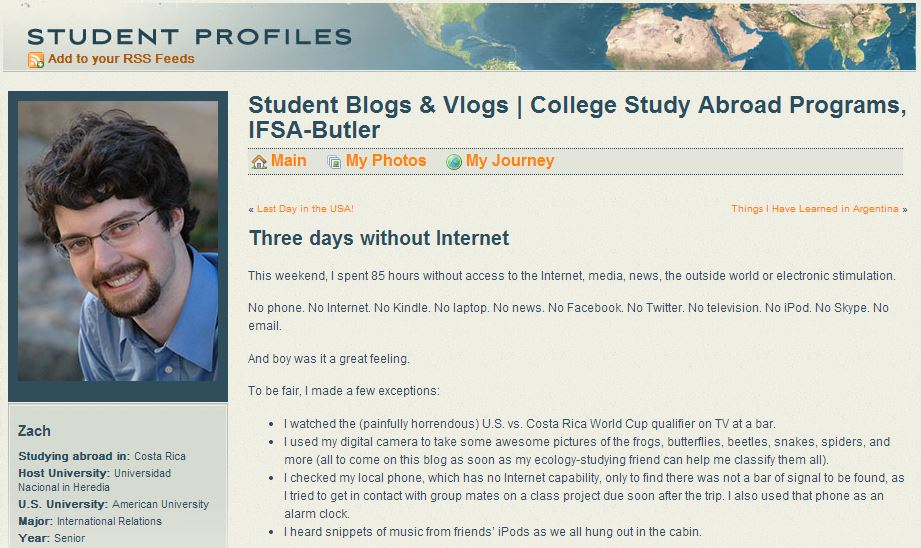
IFSA blog 9.11.13

I announced on this blog last week that I was going on a tech detox.

Here’s how I did:

This weekend, I spent 85 hours without access to the Internet, media, news, the outside world or electronic stimulation.

No phone. No Internet. No Kindle. No laptop. No news. No Facebook. No Twitter. No television. No iPod. No Skype. No email.

And boy was it a great feeling.


Maybe you’ve always had an idea for a book but were too daunted by the traditional gatekeepers of agents and publishers. Well now you can dust off the manuscript and get read to publish, because the growth of self-publishing services and social media makes it easier than ever to self-publish your book. But whether you self-publish or have a traditional book publisher, you’ll need to do more marketing, more outreach, more organizing — more of everything! Authors are really becoming entrepreneurs, needing to understand the business of book publishing more than ever (even if they never thought they’d need to know this). This week’s Mediatwits talks to successful self-published authors as part of our “Authors as Entrepreneurs” special, including self-published author, expert and MediaShift contributor Carla King and successful self-published authors Darcie Chan and Hugh Howey. MediaShift’s Mark Glaser hosts, along with Mónica Guzmán from the Seattle Times and GeekWire and Andrew Lihfrom American University.

See all of the latest PBS Mediashift research on this topic, as well as bios of the panelists.

This was my last podcast I helped produce for MediaShift before I left Sept. 4.

How can journalists fight the war on journalism, both in the U.S. and abroad? As governments hunt down whistleblowers, leakers and journalists alike, many reporters are worried they now work in a world that criminalizes their profession, calling this a “DEFCON 2 journalism event.” Most recently, Chelsea (formerly known as Bradley) Manning, the source of the Wikileaks disclosures three years ago was sentenced to 35 years in prison, and David Miranda was detained in Heathrow airport for nine hours while helping his partner, the Guardian’s Glenn Greenwald, obtain documents related to NSA spying. How worried should journalists be when reporting on political, international affairs or national security? How should journalists work in the surveillance state and continue to report? This week’s Mediatwits will feature Tow Center director and former Guardian editor Emily Bell, NYU J-school professor and PressThink blogger Jay Rosen and Free Press’ Josh Stearns. MediaShift’s Mark Glaser hosts, along with Ana Marie Cox from The Guardian, Mónica Guzmán from the Seattle Times and GeekWire and Andrew Lih from American University.

Get the full rundown and guest bios here.

PBS clip 8.30.13

How will we teach the next generation of the journalists?

Such is the question raised in PBS MediaShift’s “Back to J-School” special, and we want you to help us find out.

Will J-schools flip the curriculum, focusing more on digital skills than journalism basics? Will they flip the classroom, moving most learning online and turning class time into lab time?

Or will they embrace MOOCs and other forms of online class offerings as a component of the future of journalism education?

Check out the current list, and add to it! This is my first official attempt at crowdsourcing, and I want you to be a part of it.

IFSA blog 8.26.13

Maybe it was the heat. Maybe it was the sun. Or the weight of my backpack. Or of my clothes. Or a combination of them all.

Either way, one part of this journey to the top of Cerro Chato (literally, “Flat Hill”) involved lying down in the middle of the path hypervenilating.

This hill was anything but flat. 8 kilometers round-trip at a very steep incline. I was clammy, sweaty, and ready to give up and head right back down the mountain to the hostel.

Lucky the bottom half of my pants could zip off. Lucky that I could take my shirt off to prevent overheating. Lucky I brought enough water to keep me hydrated.

And I’m very lucky to have two good friends to share the literal load on my shoulders and take as many breaks as we needed to make it to the top.

And boy was it worth it.

Check out photos of the magnificent view. 

(For the record, I’m still too sore to walk.)

Check out my latest photos of my trip to Costa Rica.  

This first batch is from a trip to Cartago for el Día de la Virgen de los Ángeles, the annual pilgrammage to the church of Costa Rica’s patron saint. 

The second is from a trip to a zoo near my home in Heredia, called INBioparque. Lots of beautiful butterflies, flowers, animals, insects, trees and more. 

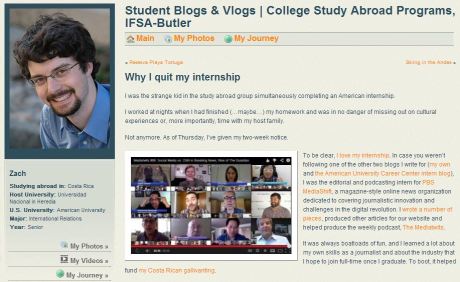
'Why I quit my internship'

It’s with a heavy heart that I announce that I’ll be leaving PBS MediaShift (and it’s podcast, Mediatwits) on Sept. 4.

Long story short, I realized I needed to spend more time on my academic pursuits (especially when all of my homework is in Spanish) and exploring Costa Rica to its fullest extent.

Read this post on IFSA-Butler’s Study Abroad blog on my reasoning to give up the best internship I’ve ever had.

Thanks to Steff Dazio, Paige Jones, Rachel Karas and probably other people who told me to do this a long time ago and waited for me to make my own decision. I appreciate your patience and your concern for my well-being.


Digital disruption has changed the landscape of the media world, and journalism and communication schools need to figure out how to educate in a time of vast change. The schools themselves need to change too, or risk falling behind. As part of this week’s special “Back to J-School 2013,” in-depth report at MediaShift, this episode of the Mediatwits will talk to students and professors alike on the value of a journalism education, the future of education innovation and more. Special guests this week are Howard Finberg, creator of NewsU at the Poynter Institute;Eva Avenue, former editor-in-chief of the Daily Lobo at the University of New Mexico; and San Diego State University professor and Knight Center MOOC coordinator Amy Schmitz Weiss. MediaShift’s Mark Glaser hosts, along with Andrew Lih from American University.

Check out a rundown of all the latest research on this topic, as well as guest bios.

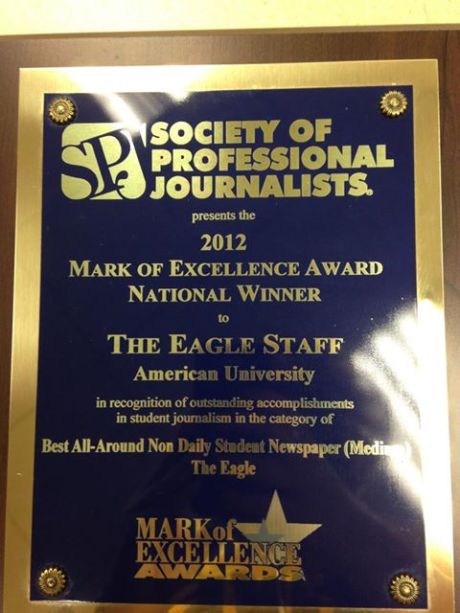
The Eagle, nationally recognized

Photo by Eagle Editor-in-Chief Paige Jones.

Sometimes, for all the literal blood, sweat and tears, I wondered if it was worth it.

The answer was always “yes.”

Award or no, my experience working at The Eagle, including more than a year as editor-in-chief, has been the defining moment of my education, even though I wasn’t even a J-school major.

I could not be more proud of our team of reporters, editors, photographers, designers, business staff, you name it. It belongs to each and every one of them.