Archives for category: Journalism


It’s a scary but exciting world for newspaper owners right now, especially if they’re in a selling mood. Jeff Bezos, the founder and CEO of Amazon, bought the Washington Post last week (while our podcast was on vacation — great timing!), and Red Sox owner John Henry bought the Boston Globe before that. As newspapers continue to struggle to raise advertising or subscription revenue, will the journalism industry be aided or hindered when it’s owned by billionaires? Special guests Nick Wingfield from the New York Times and Jack Shafer from Reuters join this week’s episode of the Mediatwits. MediaShift’s Mark Glaser hosts, along with Mónica Guzmán from the Seattle Times and GeekWire, Ana Marie Cox from the Guardian and Andrew Lih from American University.

 
Check out guest bios and story research.

'Storify: Jeff Bezos Shocks the World, Buys Washington Post'

D.C.’s hometown paper announced Aug. 5 that Jeff Bezos, founder of Amazon, bought the Washington Post and a number of other Post Co.-owned newspapers for $250 million. The Post has been controlled by the Graham family for 80 years. Here’s how journalists — at the Post and beyond — reacted to the news, as well as all the background on Bezos and his deal with the Grahams.

See the full Storify here.

UPDATE Aug. 7, with reader reactions:

I don’t always read Storifys about breaking media news, but when I do, I prefer Storifys compiled by Zach C. Cohen.
Rhys Heyden, staff writer San Luis Obispo New Times and former classmate at American University

washingtonpost.com front page, Aug. 5, 2013

washingtonpost.com front page, Aug. 5, 2013

The Washington Post announced this afternoon that Jeff Bezos, the founder of Amazon, will buy the venerable paper and a number of other Post Co. newspapers for $250 million.

For any D.C. denizen, and for journalists across the world, this will come as a shock with a mix of apprehension.

I’m most certainly in that camp. Granted, it’s not surprising that The Post would need drastic change to survive the Internet age, like other newspapers across the country.

But the fact that the Graham family would sell the paper, and to the guy who founded Amazon to boot, seems just a little bizarre.

But let’s put this deal in perspective. The reporters and editors of The Post will still produce incredible journalism. All of the top management people are staying, including Katharine Weymouth, the fourth generation installment of the Graham family, who has owned The Post for 80 years. Bezos said he won’t even be involved in the day-to-day workings of the newspapers he just bought. And to clarify, Bezos is the sole owner of The Post, not Amazon. It seems The Post’s tradition of proprietary ownership is alive and well.

The Post already has an excellent leadership team that knows much more about the news business than I do, and I’m extremely grateful to them for agreeing to stay on.

– Jeff Bezos

Who owns the company won’t change the paper’s reporting excellence.

Especially over the past four decades, The Washington Post has earned a worldwide reputation for tough, penetrating, insightful, and indispensable journalism. With the investment by Mr. Bezos, that tradition will continue.

-Katharine Weymouth

To be blunt, not all of Bezos’s investments have worked (see Pets.com and Kozmo.com).

However, according to the Washington Post:

Amazon’s sales have increased almost tenfold since 2004 and its stock price has quadrupled in the past five years.

It’s easy to see why. Bezos founded a company that has revolutionized more than one media industry. Just think about “Earth’s Largest Bookstore,” the Kindle, Kindle Singles (Amazon’s own brand of journalism).

In naming Bezos its “Businessperson of the Year” in 2012, Fortune called him “the ultimate disrupter…[who] has upended the book industry and displaced electronic merchants” while pushing into new businesses, such as TV and feature film production.

People much smarter and more well-informed than I will bring new facts to light and new analysis over the next few days. Take those predictions, and my own, on the future of D.C.’s hometown paper with a grain of salt. If somebody had the secret potion to make journalism profitable, we haven’t heard from them.

I’m optimistic that Jeff Bezos is just what The Post and affiliated newspapers need to thrive, not just survive.

Full disclosure: I am a daily print subscriber to The Post as well as an avid Kindle user, despite that one time Amazon failed to send me a book after I paid for it (don’t worry, I got a refund). 

Sources

AU Career Center blog 8.4.13

I’ve been asked a lot recently — by friends in the U.S., by American friends in Costa Rica, by Costa Rican friends in Costa Rica — why I’m continuing my internship at PBS MediaShift while studying abroad at la Universidad Nacional.

It’s a two-pronged answer, one answer more honorable than the other.

Read the rest of the post here.


Google Glass could have a transformative effect on journalism, especially as we watch Tim Pool from VICE use Google Glass to report on Turkish protests. But it’s important to examine the shortfalls as well as all the great new advancements, both real and prophesied. Special guests Rackspace’s Robert Scoble, Veterans United’s Sarah Hill, CUNY’s Jeff Jarvis and USC Annenberg’s Robert Hernandez, all early adopters of Google Glass as well as social media and journalism experts, will talk about their experiences with the device and what they see as its strengths and weaknesses for its potential future in journalism. MediaShift’s Mark Glaser hosts, along with Ana Marie Cox from the Guardian and Andrew Lih from American University.

Watch or listen to the podcast here, and tune in every Friday at 10:30 a.m. PT / 1:30 p.m. ET.

"Measuring Non-Profit Newsroom Impact Easier Said Than Done" on the homepage of PBS MediaShift, 8.1.13

Non-profit newsrooms, and the organizations that fund them, stand to gain a great deal by knowing the impact of their reporting on local communities.

But impact is not easy to compute, according to a recent report from the Investigative Reporting Workshop (IRW) at American University’s School of Communication in Washington, D.C.

“There is a discussion that has been going on now for a few years … There’s still not a complete consensus,” said Chuck Lewis, co-author on the study. He is the founding executive editor of the non-profit IRW, the largest university-based reporting center in the country.

Read the rest of the story here. 


When a blogger or journalist furthers their personal brand within a newsroom, who benefits? The New York Times’ Nate Silver is moving his FiveThirtyEight empire to ESPN, the Washington Post is launching a tech policy blog, and the Times quietly killed its Media Decoder blog (which had no guiding personality). Which blogs work for which newsroom? How important is the blog chief’s notoriety to the blog’s success? The Daily Dish’s Andrew Sullivan, social media guru Sree Sreenivasan of the Metropolitan Museum of Art and Tim Lee of the Washington Post will join us for a discussion of big-name blogging’s place in media organizations. MediaShift’s Mark Glaserhosts, along Andrew Lih from American University and former paidContent editor Staci Kramer.

You can watch the podcast LIVE every Friday at 10:30 am PT /
1:30 pm ET.

This slideshow requires JavaScript.

All part of my reporting for Latin Pulse for story in this broadcast:

Like most media, the future of television is online. This edition of the Mediatwits, we’ll talk about the prospects for tech upstarts Apple, Google, Intel and Sony, who are trying to push their way into the lucrative TV and entertainment business. Apple is aiming to work with incumbent cable companies, while Google is working against them. Meanwhile, Netflix’s original content has planted it on the same Emmy stage as major television networks and cable channels, winning 14 Emmy Award nominations. Plus, the winner of the bidding for buying Hulu was… Hulu? Hulu didn’t sell itself in the end, probably because it’s worth more than even the generous offers. Special guests Brian Stelter of the New York Times and Tracy Swedlow from the TV of Tomorrow show will parse out the future of online TV viewing and the role of Silicon Valley in Hollywood. MediaShift’s Mark Glaser hosts, along with Mónica Guzmán from the Seattle Times and GeekWire, and Andrew Lih from American University.

Get all the latest news on these subjects, along with bios of the guests.

The Eagle, American University’s student newspaper, has an agreement to syndicate quality content through UWire to other college newspapers.

A pleasant surprise: Three of my articles written for the newspaper were picked up for UWire for syndication.

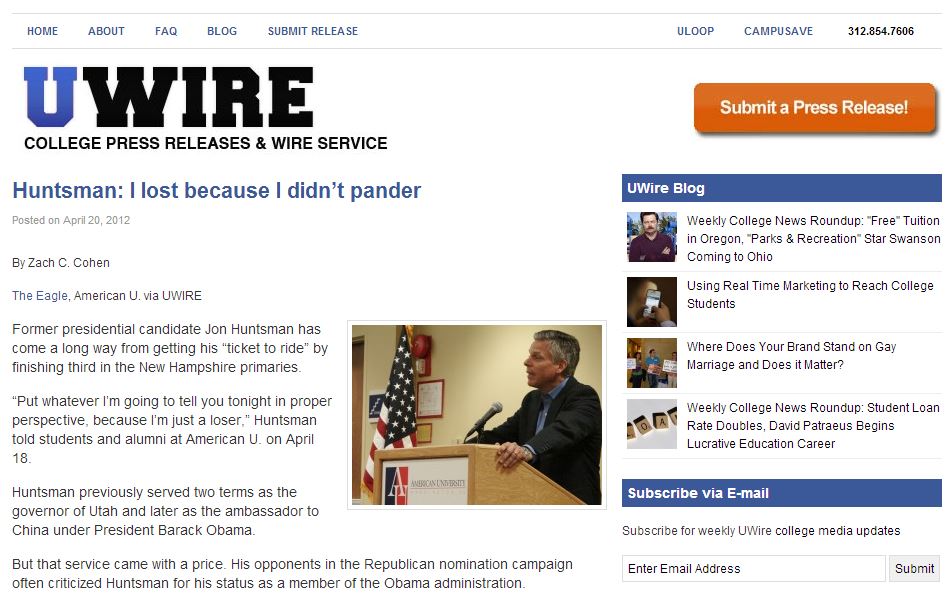
Zach Cohen's syndicated story via UWire headlined "Huntsman: I lost because I didn't pander," originally published by The Eagle

Huntsman: I lost because I didn’t pander

Former presidential candidate Jon Huntsman has come a long way from getting his “ticket to ride” by finishing third in the New Hampshire primaries.

“Put whatever I’m going to tell you tonight in proper perspective, because I’m just a loser,” Huntsman told students and alumni at American U. on April 18.

Zach Cohen's syndicated story via UWire headlined "D.C. students react to East Coast earthquake," originally published by The Eagle

Students rally against student debt at Sallie Mae headquarters

American U. students joined their peers from other D.C. universities to protest high student loan debt on Oct. 28.

Protestors, including about a dozen AU students, marched in the streets from an Occupy D.C. camp in McPherson Square to the D.C. headquarters of Sallie Mae, a company that provides student loans.

On the way, the group of students and some teachers blocked the streets, making it impossible for traffic to pass.

Shouts of “Hey hey, ho ho, student debt has got to go,” and “When education’s under attack, what do we do? Stand up, fight back,” filled the air during the mile-long walk.

Zach Cohen's syndicated story via UWire headlined "Students rally againsdt student debt at Sallie Mae headquarters," originally published by The Eagle

D.C. students react to East Coast earthquake

American U. evacuated all on- and off-campus buildings for a short period of time following a 5.9 magnitude that rocked the eastern United States Tuesday.

No one on campus was injured in the earthquake and there was no apparent damage to any AU buildings, according to emails from the University.

The earthquake, centered in Mineral, Va., started around 1:51 p.m. and lasted less than a minute.

Do you know where these stories eventually appeared? Because I don’t. UWire asks its clients, of which The Eagle is one, to publish the story in print, not online, to retain the value of the original publisher’s post.

If you saw these stories in print anywhere other than The Eagle, please let me know and comment on this post.