I’ve been asked a lot recently — by friends in the U.S., by American friends in Costa Rica, by Costa Rican friends in Costa Rica — why I’m continuing my internship at PBS MediaShift while studying abroad at la Universidad Nacional.
It’s a two-pronged answer, one answer more honorable than the other.
Google Glass could have a transformative effect on journalism, especially as we watch Tim Pool from VICE use Google Glass to report on Turkish protests. But it’s important to examine the shortfalls as well as all the great new advancements, both real and prophesied. Special guests Rackspace’s Robert Scoble, Veterans United’s Sarah Hill, CUNY’s Jeff Jarvis and USC Annenberg’s Robert Hernandez, all early adopters of Google Glass as well as social media and journalism experts, will talk about their experiences with the device and what they see as its strengths and weaknesses for its potential future in journalism. MediaShift’s Mark Glaser hosts, along with Ana Marie Cox from the Guardian and Andrew Lih from American University.
Watch or listen to the podcast here, and tune in every Friday at 10:30 a.m. PT / 1:30 p.m. ET.
Non-profit newsrooms, and the organizations that fund them, stand to gain a great deal by knowing the impact of their reporting on local communities.
But impact is not easy to compute, according to a recent report from the Investigative Reporting Workshop (IRW) at American University’s School of Communication in Washington, D.C.
“There is a discussion that has been going on now for a few years … There’s still not a complete consensus,” said Chuck Lewis, co-author on the study. He is the founding executive editor of the non-profit IRW, the largest university-based reporting center in the country.
When a blogger or journalist furthers their personal brand within a newsroom, who benefits? The New York Times’ Nate Silver is moving his FiveThirtyEight empire to ESPN, the Washington Post is launching a tech policy blog, and the Times quietly killed its Media Decoder blog (which had no guiding personality). Which blogs work for which newsroom? How important is the blog chief’s notoriety to the blog’s success? The Daily Dish’s Andrew Sullivan, social media guru Sree Sreenivasan of the Metropolitan Museum of Art and Tim Lee of the Washington Post will join us for a discussion of big-name blogging’s place in media organizations. MediaShift’s Mark Glaserhosts, along Andrew Lih from American University and former paidContent editor Staci Kramer.
You can watch the podcast LIVE every Friday at 10:30 am PT /
1:30 pm ET.
If you’re not a friend of mine on Facebook (sorry), you probably haven’t seen many pictures yet of my tour through the beautiful country of Costa Rica.
Check out the pictures on my ongoing blog at IFSA-Butler, my study abroad program. This time, I feature San José, the capital of Costa Rica, and la Rincón de la Vieja, an active volano.

I told my host mom the day I moved in that my Internet didn’t work.
15 minutes later, four different ticos, from at least three generations of the same family, were in my room (pictured here) trying to get my computer to work.
Like most media, the future of television is online. This edition of the Mediatwits, we’ll talk about the prospects for tech upstarts Apple, Google, Intel and Sony, who are trying to push their way into the lucrative TV and entertainment business. Apple is aiming to work with incumbent cable companies, while Google is working against them. Meanwhile, Netflix’s original content has planted it on the same Emmy stage as major television networks and cable channels, winning 14 Emmy Award nominations. Plus, the winner of the bidding for buying Hulu was… Hulu? Hulu didn’t sell itself in the end, probably because it’s worth more than even the generous offers. Special guests Brian Stelter of the New York Times and Tracy Swedlow from the TV of Tomorrow show will parse out the future of online TV viewing and the role of Silicon Valley in Hollywood. MediaShift’s Mark Glaser hosts, along with Mónica Guzmán from the Seattle Times and GeekWire, and Andrew Lih from American University.
Get all the latest news on these subjects, along with bios of the guests.
Today was my last full day in Liberia, one of the bigger cities in Guanacaste, the northwest region of Costa Rica.
I had a great time climbing volcanoes, touring the clubs and dancing/singing with ticos.
But one the best, worst parts of my first week here: Spanish.
Read the rest of the post here.
UPDATE: July 22
I misspoke in the original headline, “Learning Spanish, poco por poco.” The saying is, “poco a poco.” Clearly I’m not learning Spanish as quickly as I thought. h/t to Paige Jones for pointing out the error.
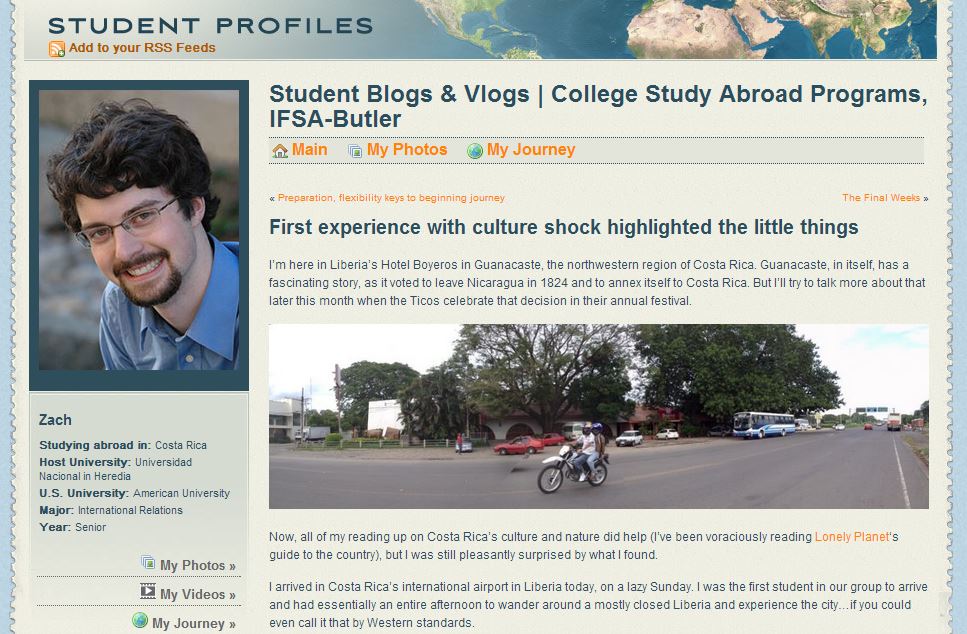
I’m here in Liberia’s Hotel Boyeros in Guanacaste, the northwestern region of Costa Rica. Guanacaste, in itself, has a fascinating story, as it voted to leave Nicaragua in 1824 and to annex itself to Costa Rica. But I’ll try to talk more about that later this month when the Ticos celebrate that decision in their annual festival.
Now, all of my reading up on Costa Rica’s culture and nature did help (I’ve been voraciously reading Lonely Planet‘s guide to the country), but I was still pleasantly surprised by what I found.